
Climbing the Walls of Our Phonemic Chasm

Have you ever heard of a Phonemic Chasm? No? ...Well, that's probably because I made up the term. But the gap it describes is 100% real and very well-documented.
So what is it? Let me tell you a story...
Decades ago I went to an international volunteer workcamp in Germany. I found myself in a cohort of young people from many different countries.

We were all brand new to each other and, of the half who hailed from outside Germany, each came from a different country and spoke a different native tongue. Among the other international participants was an African journalist slightly older and more worldly than the rest of us. His name was, to the best of my recollection, Yeboah.
We were all off to a great start with enthusiasm and budding friendships, shoveling dirt together in the bucolic Spree Forest - at least so I thought.

But then a few days into that first week, Yeboah stopped answering when I said his name. I felt confused, frustrated, and not a little intimidated. As time passed and I couldn't figure out the problem, I mustered up the courage to inquire what was wrong.
It turned out Yeboah had chosen to stop responding to a sound that wasn't his name.
"I'm so sorry," I said. "What's your name again?"
"Yeboah," he said.
I was surprised – wasn’t that just what I had been saying? "Yeboah," I repeated, exactly as I understood it.
He glared and started to walk away. I stared after him, confused and upset. What was I doing wrong?
He thought I was being deliberately disrespectful.
I was trying my best to follow his wishes.
But I literally couldn’t discern the difference in the sounds.
-> Turns out, we'd fallen into a Phonemic Chasm.
It took many more tries. He'd say his name and I'd unintentionally butcher it. Understandably, he was upset. We asked other people to demonstrate his name. Except for the accents, they all sounded the same to me.
The turning point came when we focused in on the initial "Y". It turned out that the start of his name had what I remember as a puffy "J"-like sound integrated into it—a sound that I'd never heard before and had to work hard even to hear — and then to comprehend and physically produce.
Once I understood what I was missing, it was natural to try. Though I'm not sure if I ever got it quite right, he was generous, and our relationship improved.

Sometime's the problem's not the phone, it's the phoneme.
When You Can't Hear What You Don't Already Know
The missing piece here was something called a phoneme — a sound that exists in some languages and not in others. Because we haven't learned it, sometimes we actually can't hear it - or more accurately, we hear it but can't recognize it because our brains aren't interpreting it correctly.
This isn't accidental. As humans learn languages, our minds store each sound we learn as a specific item. From then on, we automatically try to match new items to the ones we already know. That pattern matching is vital — it is what lets us understand our own language across a wide variety of pronunciations and background noise.
But it also means that we default to hearing what we learned as children to understand — so that sometimes when we hear sounds, we pop into our internal library and come out with the wrong match.
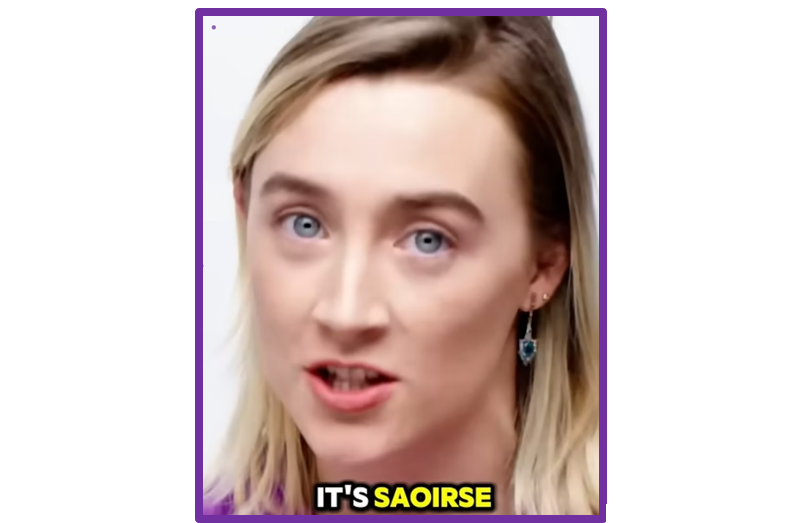
Golden Globe actress Saoirse Ronan knows this well. She finds that Americans typically cannot pronounce her first name — and moreover can't hear a difference when she corrects them — all because a vowel sound treated one way in Gaelic corresponds to a different pattern in American English. Hear it for yourself in this video.
A Universal Systems "Glitch"
Phonemic chasms appear between any culture and any language. A friend who immigrated from Bosnia to the United States has shared that it took her years to differentiate between the English words "Paul" and "poll". Her learned way of hearing registered the vowel sounds as identical.
But unless you've studied language or speech therapy, you may never have heard of a phoneme before.
In ordinary life, we just presume that what we hear is correct. And most of the time it is.
But names are important. Their pronunciation feels personal, which means that what we don't hear can create confusion and hard feelings - especially if neither party understands the shortcomings of our early neural encoding.
Understanding and bridging phonemic chasms is just one facet of Name Fluency — the approach I’m developing to help people build stronger connections through names. I'll be writing more about it in future blogs and continuing to offer free interactive workshops, so stay tuned!


Comments